Here They Lived / The Time Patterns Library / An ontology of absence
visual archaeology of domestic living
“Here They Lived” is a modular and ongoing project, designed to evolve through continuous research and site-specific adaptations. Through an ontology of absence, human presence is suggested and reconstructed through the rigor of surviving remnants- casual objects and decorative motifs that become archival witnesses of a concluded time.
the fragile imprint of habitation
The research foundation utilizes sacred geometry as a tool for a Process Art exploration of memory ephemerality. The environment becomes a repository of emotional data, a structural language through which the chaos of memory is sublimated into archetypal forms, and a Compass Rose, a Tablecloth, or an Herbarium transforme the fragile imprint of habitation into a protective structure.
conceptual and interdisciplinary dialogue
To date, the installation has been exhibited twice in 2023: first at Carol 53 in Bucharest, and subsequently at the Banca de Cultură Apollonia in Brașov, as part of the International Biennial of Contemporary Art. In both iterations, the installation was presented in a conceptual and interdisciplinary dialogue alongside the work of anthropologist Cristina Irian, bridging the gap between artistic image-research and ethnographic inquiry.
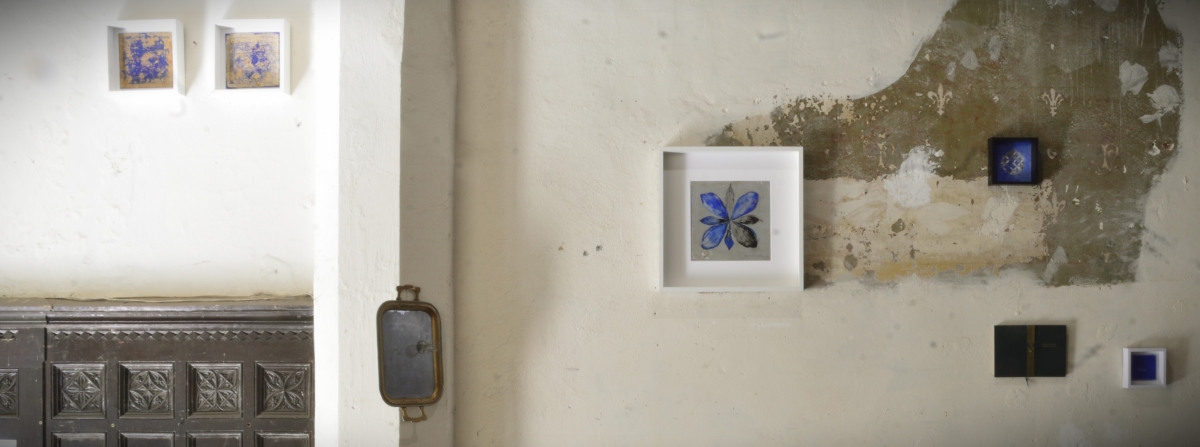
OVERVIEW
INSTALLATION | PAINTING | ASSEMBLAGE | MODULAR | EVER-EVOLVING
The Philosophy of the Dwelling Membrane
- Dwelling is not a mere physical presence in a defined space, but a continuous secretion of memory onto a sensitive membrane that absorbs the time and emotional data of existence. In “Here They Lived,” the dwelling shell is analyzed through a process of memory archaeology, where the remnants of daily life function as archival witnesses of human ephemer passings through life.
- The investigation focuses on the concept of the “box”—the home as a three-dimensional container, and the mind adding a fourth dimension: the inside that tracks how presence adheres to texture and form. This logic of reconstruction documents persistence in spaces where the inhabitant is defined exclusively through the rigor of their absence, transforming the common object into a mirror of concluded time.
Sacred Geometry as Universal Syntax
- Time traverses the memory of dwelling as a flux of invisible winds that, in the absence of a structure, would disperse any trace of identity. To counteract this erosion, the spirit resorts to a syntax of the image based on sacred geometry, where the triangle, circle, and square are fundamental instruments for the sublimation of nature.
- This geometry becomes a fixed visual coordinate that translates temporal flux into a perceptible stability. The decorative patterns that accompanied decades of dwelling—motifs deliberately chosen by those who occupied the space—persist as witnesses of their identity and time. The research operates through a sensory archive of signs where the concept of The Compass Rose (Roza Vânturilor) symbolically maps the “winds of time,” providing an ordered structure to the fragmented memory of the house . Through archetypes such as The Oculus or Nimbus, the mundane traces of the day undergo a process of sacralization, transforming the circular imprint of a daily gesture into a symbol of protection. Within this topography of the soul, structures exploring the Herbarium (Plant Trace) concept probe the “spiritual musculature” of the space, reflecting a deep connection between nature and the image, where the plant trace becomes the silent witness to the organic growth of memory.
Materiality and the Silent Witness: A Liturgy of the Mundane
- In this archaeology of dwelling, the use of simple, often “humble” materials—such as linden wood, cotton canvas, or silk paper—bestows upon the process its own historical and sensory weight. These elements, integrated through techniques of ready-made and assemblage, carry the weight of past lives and act as silent witnesses to the everyday. The decorative fragment ceases to be an inert background, becoming a mediator that facilitates access to the psychic spaces delimited by the objects that once surrounded us. Each recovered object is treated as an extension of a concluded living, generating a “liturgy of the mundane” where materiality bears the imprint of human gesture and ensures the transition from forgotten object to persistent symbol
 roxana DONALDSON