threads+traces (maria)
This modular installation operates as a visual instrument for examining memory, loss, and systems of order. Originating from a personal absence, Maria exceeds the individual, becoming a shared figure—one that carries the accumulated presence of mothers, daughters, and grandmothers whose lives are sustained through repetitive, often unseen gestures. The name resists singularity. Through its recurrence across cultures, it becomes anonymous—detached from a single identity and absorbed into a collective structure.
The full installation dossier can be accessed through the links below.
The Story: A Farewell to Maria
Threads + Traces is a long-delayed gesture of return.
Maria—the artist’s grandmother—disappeared in 1977, during a catastrophic earthquake. What remains is not a narrative, but a fragmented field of traces. Rather than reconstructing a biography, the work approaches absence as a system: a space where memory persists through repetition, erosion, and partial reconstruction. Maria becomes less a person to be remembered, and more a structure through which memory continues to operate.
A Three-Axis Visual Language
1. The Written Sign (Linguistic Code)
The name Maria is repeatedly inscribed until it loses legibility. Through accumulation, it shifts from language into surface—no longer read, but seen. What remains is the residue of an attempt to hold an identity in place.
2. The Threads (The Physical Tension)
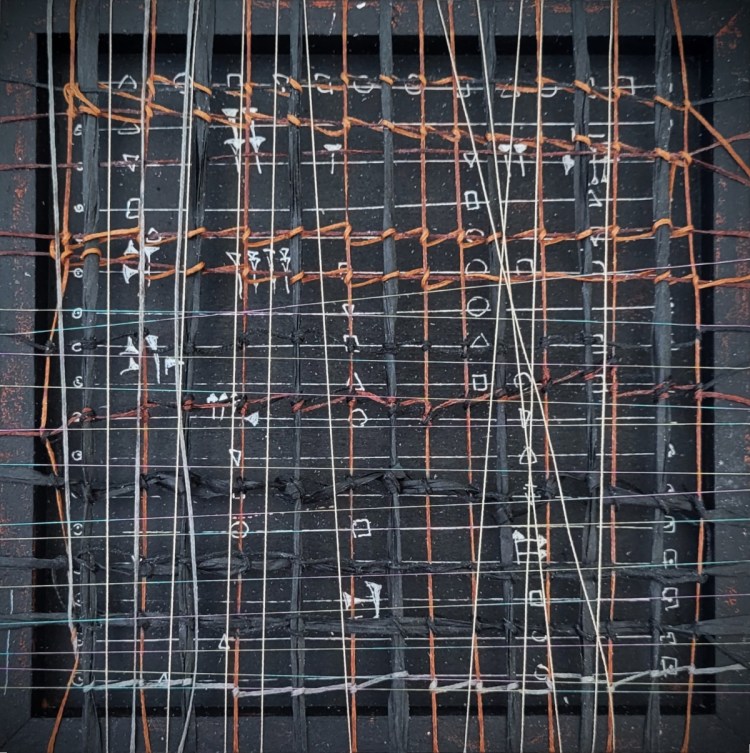
Threads—wire, silk, wax—extend across surfaces and into space. They introduce tension, connection, and resistance. Not illustrative, but structural: lines that bind, pull, and hold fragments together.
3. The Traces (The Conceptual Archive)
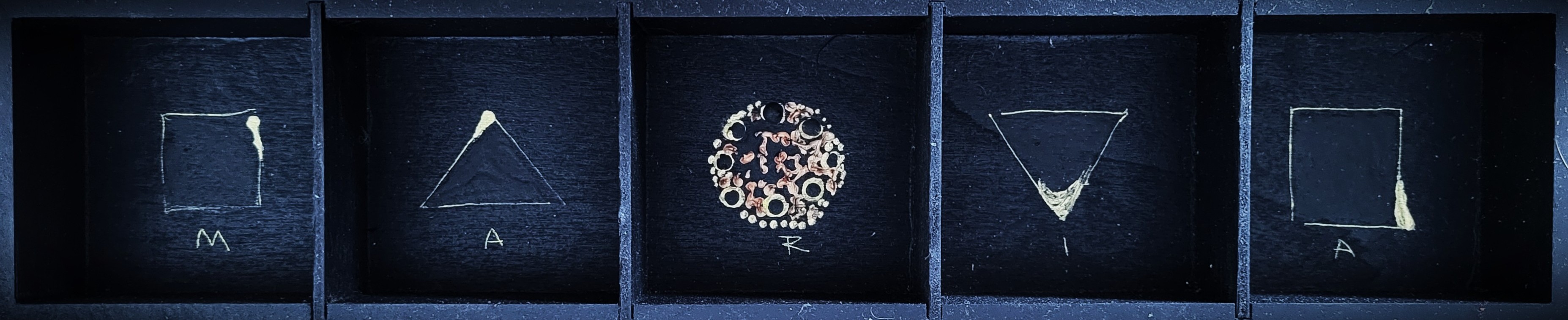
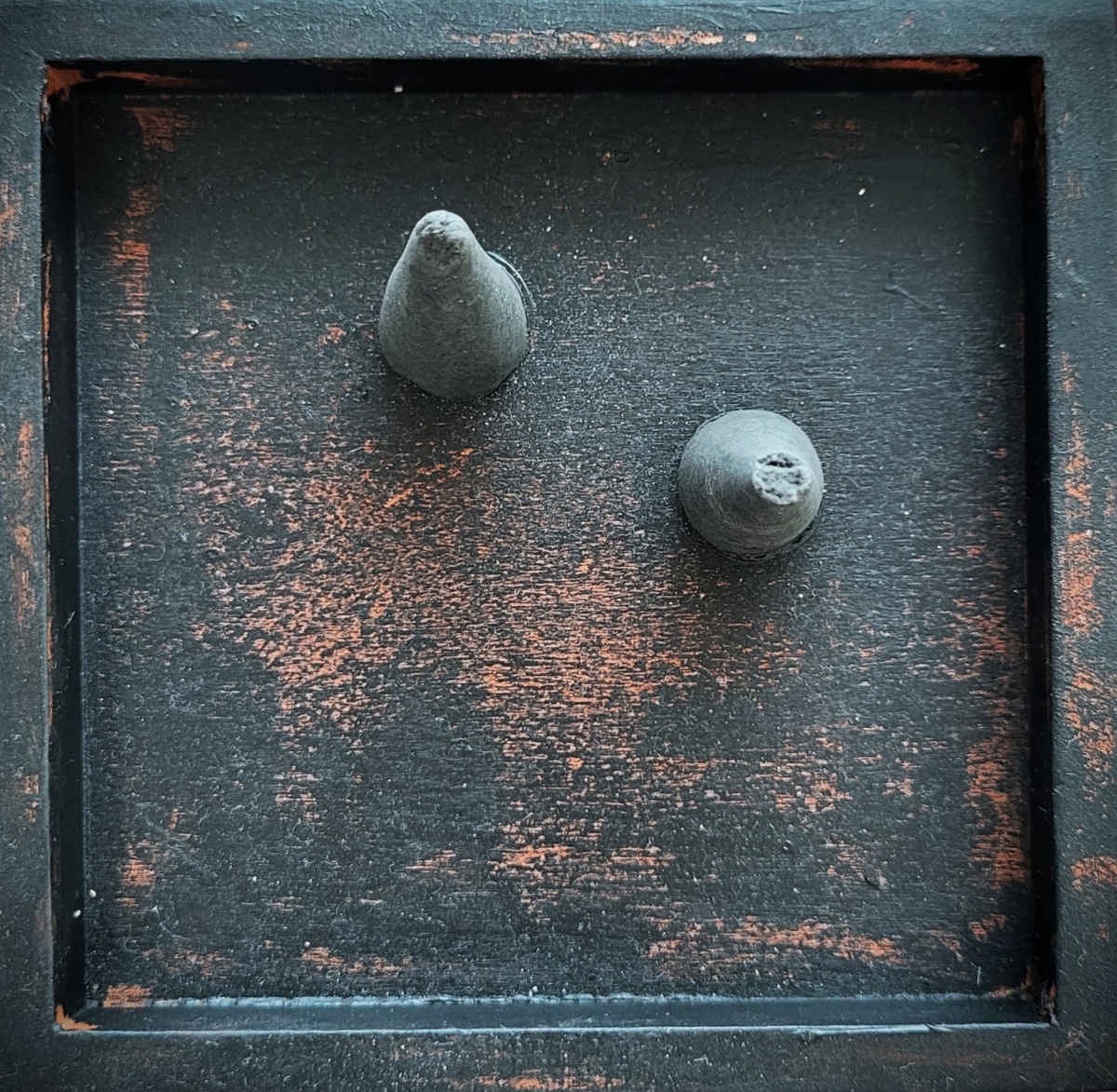
A personal indexing system of geometric signs, numbers, and clay forms. These elements function as a private archive—an attempt to register what escapes language.
Reduced, coded, and reorganized, experience is translated into a stable, repeatable structure.Materials and Technique
Painting and archival structures emerge from reclaimed domestic materials.
The Paintings are developed on recycled bedsheets, where layers of pigment, abrasion, and inscription accumulate over time. The surface retains evidence of both use and intervention.
The Archival boxes—formed from eroded wood—contain clay cones, wood fragments, seeds, and knotted threads. These elements are assembled as compact units, holding together dispersed fragments.
OVERVIEW
INSTALLATION | PAINTING | ASSEMBLAGE | MODULAR | EVER-EVOLVING
Mapping the Cycle of Life
The installation traces repetitive structures embedded in lived experience. Daily gestures—often unnoticed—form patterns that accumulate, exhaust, and persist.
Within these cycles, individual identity becomes increasingly diffuse, absorbed into a broader, continuous field.
The Fading Sign: Layers of Memory
Through repetition, the written word begins to dissolve. As Maria is inscribed repeatedly, its function shifts—language gives way to texture.
Layers of paint and abrasion obscure the name, not erasing it completely, but displacing it. What remains is a surface where memory is no longer stable, but sedimented.
Giving Memory a Body
Threads, knots, and compact material groupings operate as physical anchors—points where tension becomes tangible. These forms do not reconstruct the past, but hold its pressure in the present.
Absence is not illustrated, but materialized.
 roxana DONALDSON